
Lessons From San Jose

Updated: May 7
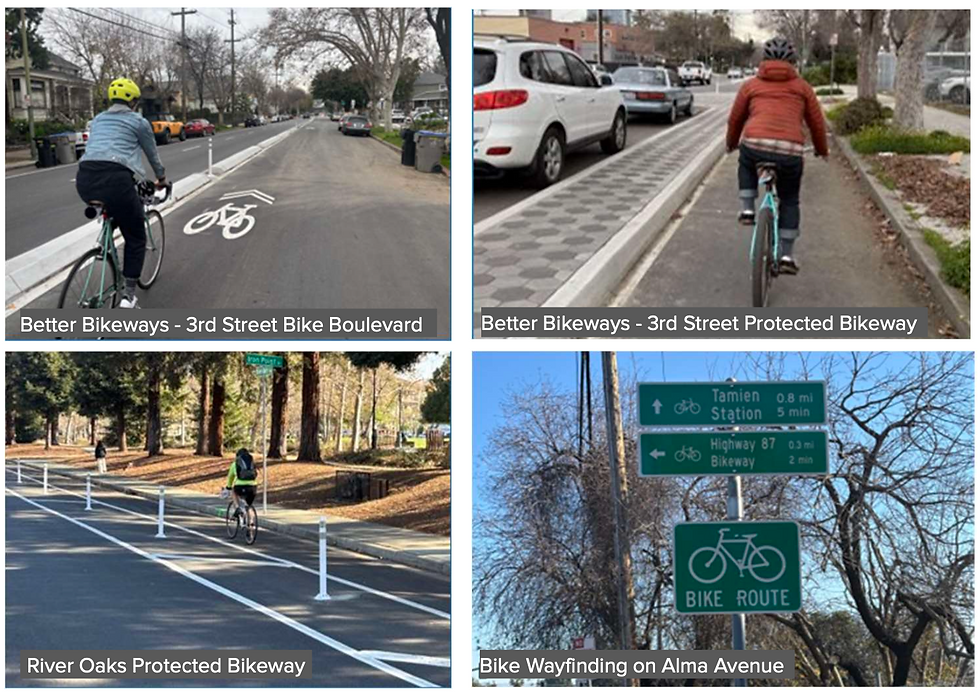
The 12th most populous city in the US, San Jose has an entrenched car culture and a large dispersed land area, making the task of building out a bike network especially challenging. But, if you were to visit downtown San Jose, you'd see impressive bike infrastructure, like parking protected bike lanes and protected intersections. The city has made significant progress, but at the same time, it has not made enough. Compared to Sunnyvale, San Jose has had more years of experience working on its bike network, so it is worthwhile to study what San Jose has done and see what lessons we can apply to Sunnyvale.
In 2009, San Jose created its first bike plan, Bike Plan 2020, and actually completed it on-time, in 2020. This bike plan implemented approximately 200 miles of bikeways, comprised mostly of basic painted bike lanes.
San Jose followed up Bike Plan 2020 with Better Bike Plan 2025, which went beyond basic painted bike lanes to more sophisticated bikeways. Its impressive goal is a 550 mile bike network comprised of several bikeway designs. One key design is protected bike lanes, which have vertical barriers separating cyclists from cars. The city is currently hardening the plastic flex posts, mostly in downtown (3rd St., 4th St., San Fernando, San Salvador). While this is great, there is no timeline or funding source to holistically convert all flex posts to concrete. The city does so opportunistically when funding is available.
Better Bike Plan 2025 also calls for bike boulevards, which are shared bike-car lanes in quiet residential streets. For bike boulevards to be successful, they must have speed-lowering infrastructure like speed humps and car volume-lowering infrastructure like diverters. These traffic calming elements were implemented on E. St. John, E. San Fernando, 10th St., and 11th St. However, some of the diverters are plastic, so cars routinely drive through them. Moreover, many bike boulevards in San Jose remain unmitigated, which could lead to unsafe and uncomfortable biking experiences on medium volume streets.
In addition, basic painted bike lanes continue to get implemented, even on high speed/high volume roads. Paint alone is inappropriate on these roads. For example, Tully Road is a 6-lane car road with drivers habitually speeding beyond the 40 mph limit. The painted buffered bike lanes without vertical protection, not even plastic, result in cars regularly encroaching into the bike lane near intersections and driveways. Although the city has adopted Vision Zero Action Plan 2025 with the philosophy that paint alone is woefully inadequate on streets with any appreciable car speed or volume, and although Better Bike Plan 2025 says the preferred bikeway design on major streets is protected bike lanes, the reality is that the city does not always manage to uphold these plans.
San Jose continues to invest in trails, which are the safest of all bikeway facilities. The city has plans to implement trails along the many waterways that run through San Jose. Progress is slow, however, and comes in fits and spurts, whenever funding is found. Out of the 47 new trail miles that were identified for implementation in 2009, only 15 miles have been completed.
Better Bike Plan 2025's goal was to have built 550 miles of bikeways by 2025, but 2025 has come and gone and the Plan is only a small fraction complete. Perhaps the Plan was too ambitious. Perhaps the pandemic threw the Plan off track. Observers are concerned that the city may not complete Better Bike Plan for another generation.
Partly the result of not having a complete and safe bike network, San Jose has not made progress toward its stated goals, as summarized in the annual 2025 update of Move San Jose, the city's plan to advance biking, walking, and transit. Vehicle miles traveled (VMT) have actually increased 13% since 2019. Bike commute mode share has remained flat since 2009, hovering around 1%. The bike-car crash rate resulting in fatal or severe injuries has not decreased. Transportation is still the largest and still growing contributor to San Jose's green house gas emissions, at 51%.
Nearby, Sunnyvale has made even less progress on its bike network. Sunnyvale is a much smaller city by area (8.2x smaller) and population (6.5x smaller). Its Active Transportation Plan (ATP), approved in 2020, has a goal of 160 miles of bikeways. Unlike San Jose's Bike Plan 2020, which was completed in 11 years and on time, progress on the ATP is following the course of San Jose's Better Bike Plan 2025. Nobody believes Sunnyvale will complete the ATP by 2030, when the plan expires.
Sunnyvale's bike network is inferior to San Jose's in terms of safe bikeway mileage per capita. The ATP goal is 18 miles of protected bike lanes, which is 3x fewer miles per capita than San Jose. Since the ATP was approved in 2020, only 1 mile of protected bike lane has been implemented in 6 years. Future implementations are likely to use plastic flex posts, which offer no protection from car intrusion.
In contrast, Sunnyvale's "bike boulevards" have almost all been implemented (19 out of 22 miles), but these bike boulevards ironically decreased safety and comfort. They are just paint and signage; no attempt was made to slow or divert car traffic. The design prohibits drivers from passing cyclists. During school commute times, these "bike boulevards" fill with cars backed up behind bikes, with cars often illegally swerving around bikes in the oncoming car lane. Most people who bike on these roads prefer the original road design over the current one.
Like San Jose, Sunnyvale has not made progress toward its goals and has actually regressed. The bike commute mode share is stuck at 1.5%. The annual Climate Action Playbook update in 2025 reported that transportation emission has been steadily increasing since 2020 and is now about 13% higher than its 2008 baseline. The annual Vision Zero Plan update in 2025 reported that the bike-car crash rate has increased 43% since 2020, when the ATP was adopted.
San Jose has made substantial progress on its bike network but not its city goals. Sunnyvale has made little progress on its bike network and its city goals. With more years of experience, San Jose can provide these valuable lessons to Sunnyvale:
When creating a bike plan, include actions that need to be taken to reach the plan's goals. Include key performance indicators to track progress.
Explore new ways of funding the bike plan since current funding options are insufficient. Consider a ballot measure to generate income for alternative transportation. Direct existing city funds toward active transportation infrastructure.
Design bikeways that adhere to the latest safety guidance. Do not compromise on bike safety, not for cost, not for car convenience.
Adhering to these lessons is non-negotiable if we are to reverse the trend to reach city goals.
About the Author

Sharlene Liu is Founder and Chair of Sunnyvale Safe Streets. She is dedicated to making Sunnyvale's streets safe for walking and biking. She believes that safe streets build strong communities.


