
Protecting our Intersections
- Steve Meier and Sharlene Liu
- Feb 28
- 5 min read
Updated: Mar 4
Intersections are the most dangerous part of the roadway. Understandably so, as they are where conflicts among road users are the most numerous. Pedestrians and bicyclists, as the most vulnerable users of the road, account for over half of fatal and severe injury crashes. To be clear, these crashes involve permanent brain injury, paralysis, loss of limb, and death. A disproportionate number of them occur at intersections.
In Sunnyvale, 57% of fatal and severe injury crashes involve pedestrians or bicyclists. Every month, a fatal or severe injury crash occurs in Sunnyvale. Of these crashes, 45% happen at intersections. [Source: Sunnyvale Department of Public Safety data over the last 10 years].
Given the severity and frequency of crashes at intersections, Sunnyvale should be focusing on making intersections safe. Unfortunately, Sunnyvale has a history of doing the opposite: the city reduces safety at intersections, by mixing pedestrians and bicyclists with cars, for the purpose of increasing car throughput. But this attitude needs to change if Sunnyvale is to meet its Vision Zero goal of zero preventable serious and fatal crashes by 2039. Since Sunnyvale's Vision Zero Plan was adopted in 2019, Sunnyvale has made zero progress toward that goal.
Two designs for improving intersection safety stand out: protected intersections and roundabouts. Setting good examples, cities near and far have been successful at reversing the rate of fatal and serious injury crashes by using these proven designs. Let's look at these two designs in more detail.
What is a protected intersection?
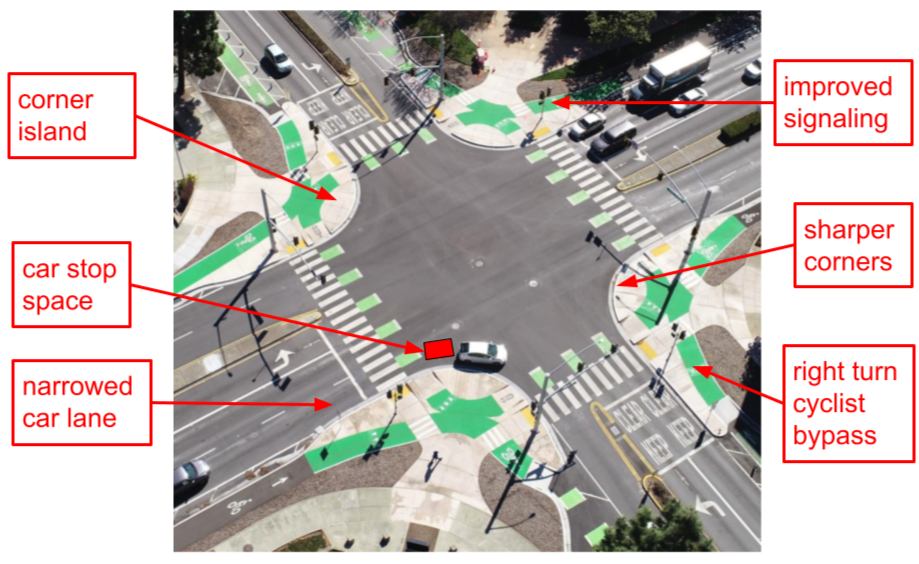
In 2015, protected intersections started being implemented in the US, and they've been proliferating ever since. They significantly reduce car crashes with bicyclists and pedestrians. Protected intersections separate bicyclists and pedestrians from vehicles and increase their visibility to drivers. A corner island is the key feature of protected intersections; it provides physical separation and guides the driver to face the bike and pedestrian crossings perpendicularly for maximum visibility. Protected intersections slow down vehicles by having sharper corners and narrower vehicle lanes. For efficiency of cyclists, they often have a right turn bypass for cyclists. Traffic signaling is designed to allow pedestrians and cyclists a head start (called a "leading pedestrian-bicyclist interval"). A scramble phase can be implemented to allow pedestrians and cyclists to cross the intersection in all directions while cars are at a standstill.
Nearby cities use protected intersections
The City of Fremont has emerged as a national leader in safe infrastructure. By implementing protected intersections at key intersections that historically saw many deadly collisions, Fremont has been able to significantly reduce their fatal and serious injury crashes. Fremont has implemented at least 13 protected intersections and plans to add more. A protected intersection in Fremont is shown in the accompanying photo, with many of the features described above.
Mountain View also has a number of protected intersections sprinkled around the city, with more planned. The intersection at Shoreline Blvd./Charleston Rd. has a protected intersection. California St. recently got several protected intersections implemented with bollards, notably at Rengstorff and Escuela. In addition, protected intersections are planned on El Camino Real at Castro, Escuela, and El Monte, and on Shoreline at Middlefield and Montecito.
Sunnyvale has no protected intersections
Sunnyvale has no protected intersections and has no plans for any. However, many locations in Sunnyvale could benefit from having protected intersections. Fremont Avenue alone presents many opportunities for installing protected intersections -- at Sunnyvale-Saratoga, Hollenbeck, and Mary. The intersections on El Camino Real and Mathilda are ideal for protected intersections as well. These are but a few locations that could use protected intersections.
What is a roundabout?
Roundabouts are circular intersections that allow cars to smoothly enter and exit the roundabout at slow speeds. Campus Drive on the Stanford Campus has several well-engineered roundabouts that separate cars from bikes and pedestrians. One such roundabout is shown in the accompanying aerial photo. Cars entering the roundabout yield to the cars already in the roundabout. Pedestrians and cyclists cross before and after the circle, allowing drivers to focus on them without being distracted by other cars.

Roundabouts are superior to traditional intersections
Compared to traditional intersections, roundabouts are far safer. Roundabouts significantly reduce fatal and injury crashes -- by 78% or more. The circular design eliminates head-on and broadside collisions. With roundabouts, conflict points reduce drastically, by 75%. As the diagram illustrates, the 32 car-car conflicts in a traditional intersection reduce to just 8 conflicts in a roundabout. The 24 pedestrian-car conflicts in a traditional intersection reduce to just 8 conflicts in a roundabout. Bikes can travel like a pedestrian or a car in these roundabouts. The circle also causes cars to slow down, typically to 10-20 mph, so that these conflicts are much less likely to result in injury.
![Conflicts reduce dramatically with roundabouts, compared to traditional intersections. Car-car conflicts reduce from 32 to 8. Pedestrian-car conflicts reduce from 24 to 8. [Diagram courtesy of Next STL]](https://static.wixstatic.com/media/6bccce_458117e4d71f4ab29386dc59e813c799~mv2.png/v1/fill/w_874,h_522,al_c,q_90,enc_avif,quality_auto/6bccce_458117e4d71f4ab29386dc59e813c799~mv2.png)
In addition, roundabouts are superior in terms of vehicular emissions, traffic flow, and maintenance costs. With little idling time -- no red lights, just merge into the roundabout when there's space -- tailpipe emissions are drastically cut. Because there's no red lights, traffic flow improves by 30%-50%. Roundabouts eliminate the need to upkeep traffic lights, reducing maintenance cost.
The first modern roundabout in the US was installed in 1990. Since then, states like New York and Virginia and cities like Carmel, Indiana have made roundabouts the default for intersection design, in place of traditional intersections. Roundabouts are an official safety intervention, as they are now one of 20 evidenced-based safety countermeasures recommended by the Federal Highway Administration.
Roundabouts in Sunnyvale
Sunnyvale has implemented 3 small roundabouts in residential neighborhoods. They are located at Elizabeth Way/Norman Dr., Canary Dr./Loch Lomond Ct., and Indian Wells Ave. near Muwekma Park.

Sunnyvale would benefit from bigger roundabouts at busier intersections too. Fair Oaks Ave., which has seen several fatalities in recent years, is an ideal candidate for roundabouts.
We hope to see future plans involving protected intersections and roundabouts in Sunnyvale. They will save lives and reduce injuries. With these and other improvements, more people will choose to walk, bike, and scooter. Mode shift to these sustainable forms of transportation will mitigate traffic congestion and climate change.
About the Author

Steve Meier is a 37-year resident of Sunnyvale. He enjoys cycling and walking. Over the years, he has noticed that it has become increasingly difficult to transit without having conflict with vehicles at intersections.

Sharlene Liu is Founder and Chair of Sunnyvale Safe Streets.


